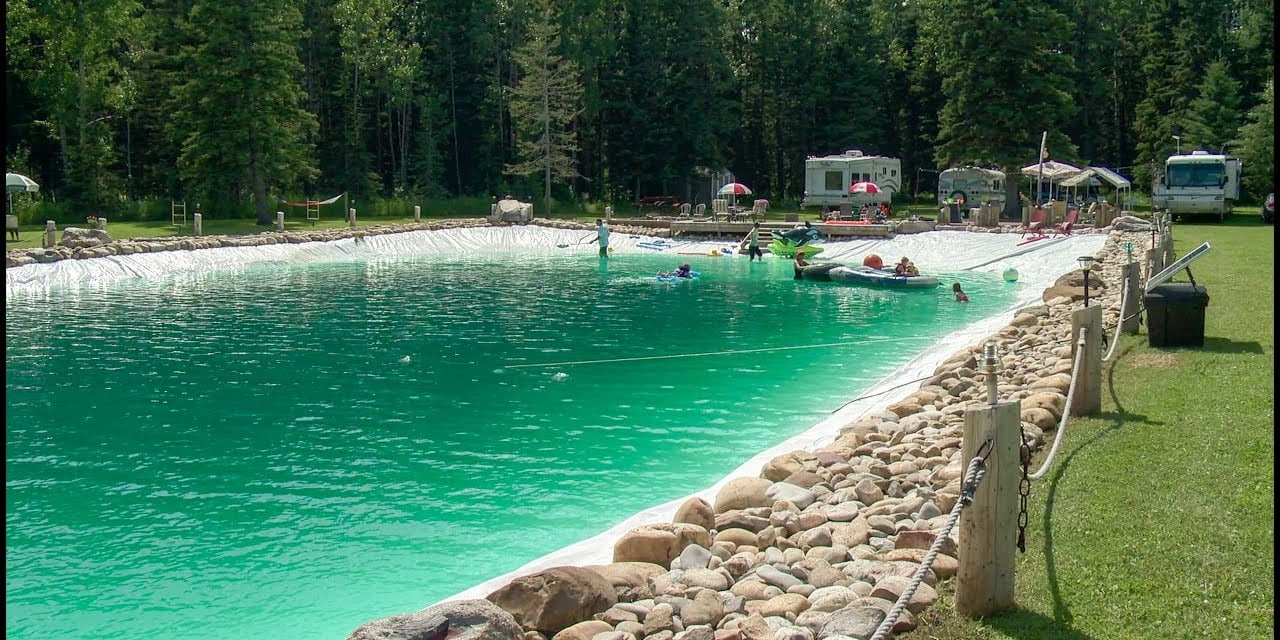
As more landowners seek eco-friendly water features beyond swimming pools, natural lakes have become a powerful alternative — whether for swimming, wildlife, irrigation or aesthetic impact. Unlike natural pools and biopools, which often require vertical walls and precision infrastructure, lakes rely on large volumes, gentle slopes and balanced ecosystems.
But how are these lakes actually built? How do they stay waterproof? And how do you keep the water clean without chemicals? This guide walks you through every step — from choosing a lining method to understanding filtration zones.
Pools vs Lakes — the key difference
The key technical distinction between natural pools and natural lakes is the edge geometry:
Natural Pools
Require vertical walls for compact swimming zones. This usually means concrete, steel reinforcement or other engineering. More controlled, more precise, higher cost per m².
Natural Lakes
Have sloped banks — often no steeper than 1:3 — allowing natural containment through landscape design, not hard structure. More forgiving, but require more space and long-term hydrology planning.
Lining a Natural Lake — 3 Waterproofing Methods
In a traditional swimming pool, waterproofing is achieved with reinforced concrete or a membrane liner. For a natural lake, those methods become cost-prohibitive at scale. Here are the three most common and effective lining systems:
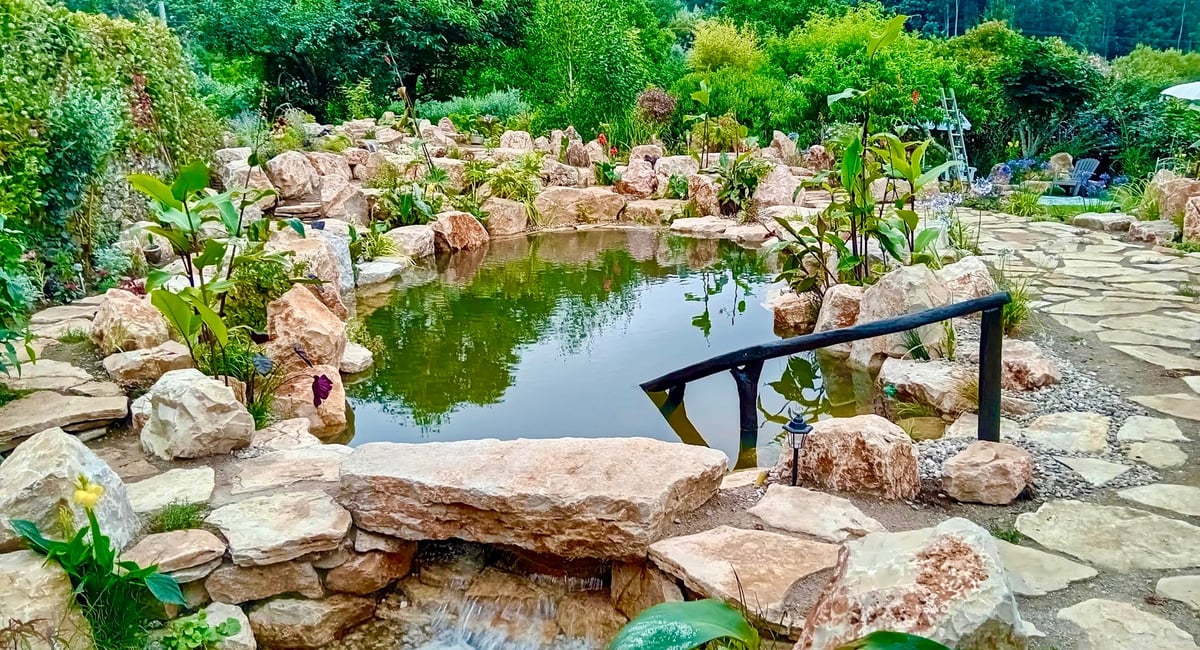
Method 1 — Clay Lining + Geotextile (Natural + Synthetic Hybrid)
A hybrid sealing method combining natural sodium bentonite clay with geotextile fabric. The geotextile acts as a stabilising and protective barrier, improving performance and durability. Once hydrated, the clay expands and self-seals while the fabric prevents displacement and erosion.
✅ Pros
Natural and eco-friendly. Self-healing — bentonite seals small cracks automatically. Erosion protection from the geotextile layer. Durable against root intrusion and animal burrowing. Cost-effective for large-scale installations, especially with locally sourced clay.
⚠️ Cons
Requires skilled installation — improper compaction causes failure. Moisture management is critical — extended drought can cause cracking. Less suitable for steep walls. Heavier earthwork requirements.
Best for: Large natural lakes and wetlands where low-impact, chemical-free sealing is desired. Projects where budget and environmental sustainability are top priorities. Remote or rural areas where synthetic liner transport is cost-prohibitive.
Method 2 — EPDM / HDPE / LLDPE Synthetic Liners
Flexible rubber or polyethylene liners are among the most impermeable and reliable methods for sealing natural swimming lakes and large ponds. Large sheets are laid across the excavation, overlapping and sealed using tape, welding or adhesives. A geotextile underlay and overlay protects against punctures and UV degradation.
✅ Pros
Extremely waterproof — near-total impermeability. Durable and long-lasting (30–50+ years properly installed). Low maintenance once installed. Steep-slope friendly. Flexible design shapes for custom basins, stairs and planted shelves.
⚠️ Cons
Expensive — high material cost for large areas. Synthetic, not biodegradable. Puncture risk if not protected by geotextile layers. Labour intensive, requires precision seaming. Needs careful edge treatment to avoid visible liner.
Best for: Natural swimming lakes with defined edges or higher water pressure. Small to medium lakes where design precision or guaranteed waterproofing is critical. Urban or semi-formal environments where longevity is prioritised.
Method 3 — Sodium Bentonite Clay (Fully Natural)
Sodium bentonite is a naturally occurring clay with extraordinary swelling and sealing properties. When applied in a concentrated layer and compacted, it forms an effective barrier to water seepage. Unlike synthetic liners, it is entirely natural and self-healing — one of the most eco-integrated sealing methods for lakes and ponds.
Bentonite is spread in a uniform layer (typically 4–10 cm), compacted using rollers or earthmovers. Once filled with water, the clay hydrates and expands, forming a dense, low-permeability barrier that can last decades with proper management.
✅ Pros
100% natural — ideal for wildlife, aquatic plants and natural aesthetics. Self-healing — clay expands to fill holes caused by movement or root intrusion. Affordable for large areas. Good thermal mass. No visible material once covered — the lake appears completely natural.
⚠️ Cons
Moisture-dependent — drought conditions can cause cracking. Not suitable for steep edges. Labour intensive — requires soil testing, application thickness and heavy machinery. Longer setup time. Performance varies by soil type.
Best for: Large lakes, wetlands or ecological restoration projects where natural integration is a priority. Budget-conscious projects needing to seal large surface areas. Clay-rich regions where native soil can be blended to reduce material cost.
Filtration in Large Natural Lakes
Lakes rely more on volume and ecosystem balance than intensive mechanical filtration. That said, clean swimmable lakes still need active design — especially for clarity and circulation.
Biological Zones
Shallow shelves with gravel and aquatic plants (iris, scirpus, pickerel, water lilies) filter nutrients and stabilise sediments. These areas may double as wildlife habitat and provide the primary biological filtration for the system.
Aeration Systems
Bottom diffused air stones or nanobubble generators prevent stagnation, oxygenate sediment layers and suppress anaerobic bacteria. Particularly effective in summer heat — critical in warm climates like California, Portugal and the Gulf.
Optional Mechanical Filtration
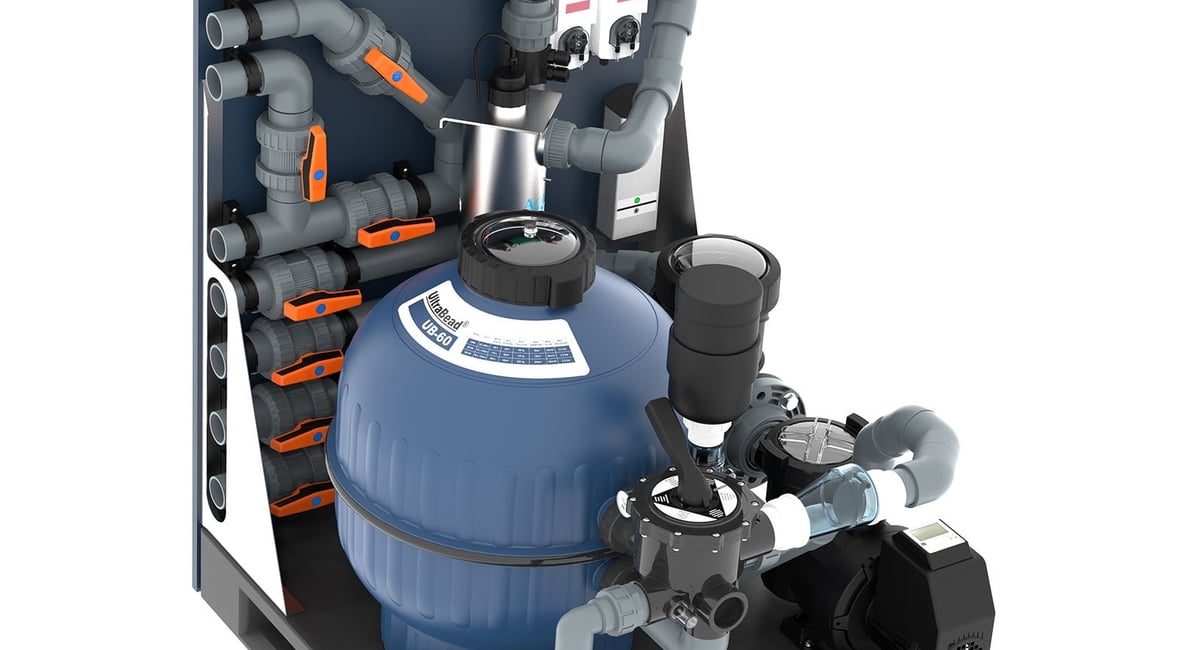
For lakes with heavy swimming use or large fish loads, additional mechanical filtration may be appropriate: surface skimmers for debris capture, drum filters for suspended solids, and BioBead filters for biological polishing.
UV-C Sterilisation
UV-C clarifiers placed at water inflow points or used in a loop recirculation system neutralise pathogens and free-floating algae spores without chemicals. In larger lakes with robust regeneration zones, UV may be optional — in smaller or heavily used lakes, it is recommended.
How Clean Can It Stay Without Chemicals?
Thanks to high water volume and surface area, lakes resist rapid shifts in pH, algae blooms and temperature swings. If designed well, a lake can remain clear and swimmable, free of string algae and surface scum, and low-maintenance.
Key design elements include:
- Proper depth zoning — ideally ≥2.5m in centre zones
- Adequate plant coverage in marginal and shallow zones
- Passive water circulation or airlift return systems
- Avoiding runoff contamination (fertilisers, livestock, etc.)
- Correct surface area to volume ratio
Design Features — Beaches, Docks & Natural Aesthetics
Natural lakes offer flexibility that rigid-walled pools cannot. Unlike pools, lakes emphasise blending into the land and invite interaction with nature, not just swimming.
Beach Entries
Gently sloped gravel entries, planted edges or soft-sand transitions. The most naturalistic approach.
Floating Docks
Anchored systems for swimming, lounging or diving. Can be seasonal or permanent.
Diving Areas
If depth allows (≥2.8m), specific plunge zones can be incorporated safely.
Planted Margins
Reeds, sedges and lilies blur the line between water and land while providing biological filtration.
How Aqua Vitae Approaches Natural Lake Design
While most builders specialise in small-scale pools, Aqua Vitae brings decades of natural system expertise to larger projects. Our process includes site-specific design and hydrology analysis, integration of natural stone paths, terracing and plant zones, filtration strategy tailored to lake size and intended use, and consultation for DIY or full-service builds.
Whether you want a swimmable private lake, an ecological feature for your property or a centrepiece for an estate — we offer the technical and artistic skill to bring it to life.
Note: The above is an adapted excerpt from our forthcoming book, Living Water: The Art & Science of Natural Pools — to be released in 2026. This comprehensive guide explores the philosophy, technology and design principles behind natural pools, ponds and lakes.